
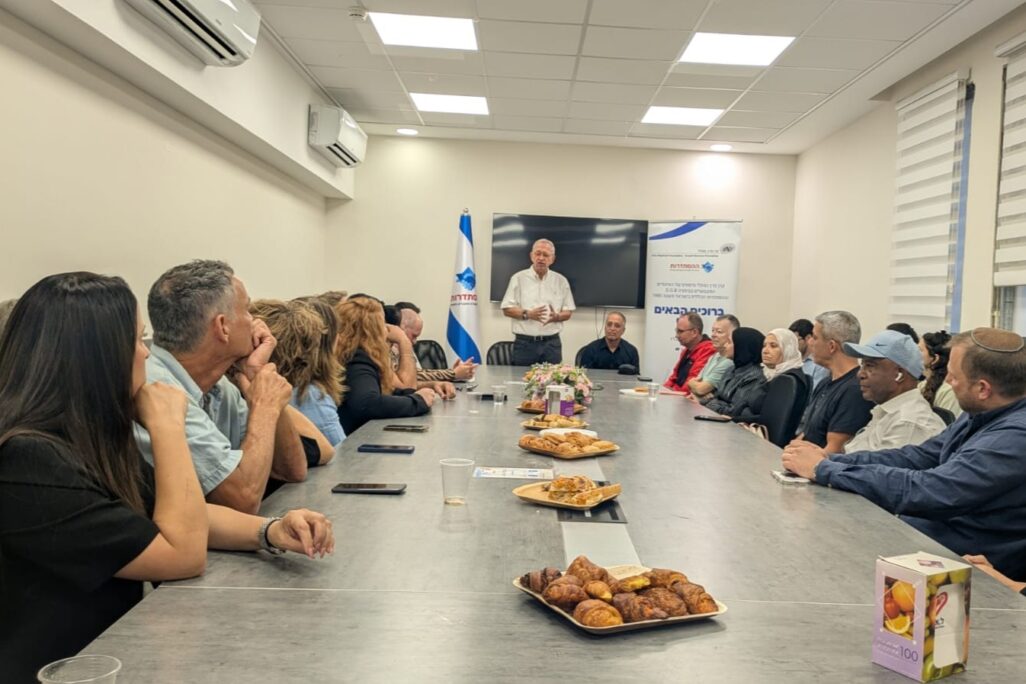
The Peretz Naftali Foundation, a non-profit organization jointly established by the Confederation of German Trade Unions (DGB) and the Histadrut, has announced the 46 organizations in Israel set to receive its annual grants. The announcement of the organizations, which focus on education, quality employment, and resilience, was made at a ceremony held at the Histadrut headquarters.
“The core of the foundation lies in the worlds of education and labor,” said Gershon Gelman, the foundation’s chair and head of the Histadrut’s International Relations Division. “But during the war, we assisted—and continue to assist—many organizations and projects focused on helping evacuees, the wounded, and people suffering from post-trauma. It was important to me to hold this ceremony here and bring the organizations together, because I believe that from here, meaningful collaborations can grow.”
Alongside Gelman, Histadrut Chief Financial Officer Gil Elimelech also presented the grants.
Organizations that received grants from the Peretz Naftali Foundation include Click Savi, an organization that promotes social entrepreneurship initiatives among the elderly; the Rahat Women’s Association, which works for the advancement of women in Bedouin society and the fight against violence toward women; Musethica, which strengthens musical education and works to bring chamber and classical music to the periphery; Beit Ruth, a youth village for at-risk girls and young women; Jordan River Village, which offers recreation and respite activities for children and youth with serious illnesses and disabilities; the Histadrut’s Amal school network; Tamkin Association, which promotes diagnosis and treatment of learning disabilities in Bedouin society; Almanal Association for integrating people with special needs in Sakhnin; Sabin al-Karmel Association, which provides intergenerational connection programs in the Druze community; and the Druze Veterans Association.
Additional organizations that received support include the Ruca’s Farm, which functions as a rehab center for discharged soldiers with PTSD; Big Brother Big Sister Israel; FIDEL Association for the Education and Social Integration of Ethiopian Jews in Israel; The Israel Sport for All Association; the Jewish-Arab Institute at Beit Berl College, which is affiliated with the Histadrut; Nevet, which provides breakfast for disadvantaged schoolchildren; Fighting Online Antisemitism; and the Lavon Institute for Labor Movement Research.
Speaking at the event, Gelman described the foundation as a deep expression of solidarity and cooperation between the trade unions of Germany and Israel. He noted that even today, decisions regarding the various grants are made by the joint management of the foundation from both organizations.
Earlier this month marked 50 years of cooperation and ties between the Histadrut and the DGB, at a joint conference named after Peretz Naftali, attended by a delegation of 75 members from the German unions.
The foundation, established in 1982, is named after Peretz (Fritz) Naftali, a Jewish journalist and economist of German origin, who served as minister of agriculture, minister of trade and industry, and minister of welfare on behalf of the Mapai party. Naftali was also a member and deputy chair of the Bank of Israel’s advisory council and a member of the Tel Aviv City Council.