



On Monday, farmers across Israel escalated their struggle against the dairy sector reform, with large scale protests at major intersections across the country. Protesters managed to block the Gilat and Megiddo junctions. According to the organizers, around 1,200 farmers took part in the demonstrations, which included tractor convoys, the pouring of milk, and the scattering of hay and straw.


The reform being advanced by Finance Minister Bezalel Smotrich would lead to the abolition of planning in the dairy sector and the opening of the dairy market to international imports. In a statement, farmers’ organizations called on the public to join the struggle against the finance minister’s intention “to eliminate Israeli agriculture and the dairy industry.”
“Along the borders, agriculture is not just an economic sector; it is an anchor of settlement and security,” said Moshe Davidovich, head of the Mateh Asher Regional Council and chair of the Border-Line Communities Forum. “After two years of war, including a year and a half of intense fighting under fire, our farmers continued to work under fire, to protect the land, and to supply food to the country, even when they had no backing. Precisely now, the government decides to promote a terrible move that directly harms communities along the border.”
MKs and council heads stand alongside the dairy farmers
Around 100 farmers, young and old, from a wide range of agricultural sectors, arrived at the Gilat Junction in the western Negev. Dagan Yarel, CEO of the Israel Dairy Producers Association, said at the protest: “On October 7, the dairy farmers and residents faced the hardest test ever to confront the people of Israel—and they won; you won. Not a single drop of milk was missing from the dairies. We will win: Israeli milk, Israeli agriculture, and food security for the citizens of Israel.”
Eddy Polanski of the Or HaNer dairy farm said: “The Ministry of Finance is harming Zionism. We are not to blame for the cost of living, we are the solution.”
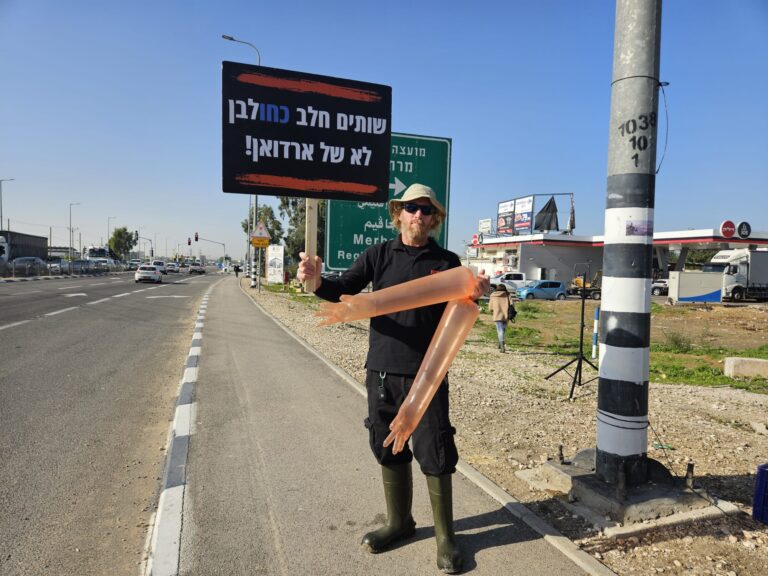

The struggle against the reform is resonating across rural areas and receiving support from the Regional Council Center, the Moshavim Movement, and the Kibbutz Movements. Shlomit Shichor Reichman, head of the Emek Yizrael Regional Council, joined the protest at the Megiddo Junction and said: “Anyone who harms the dairy sector harms our ability to produce blue-and-white food, both in everyday life and in emergencies. Emek Yizrael, which produces a fifth of Israel’s milk output, will not stand by — we stand alongside the dairy farmers.”
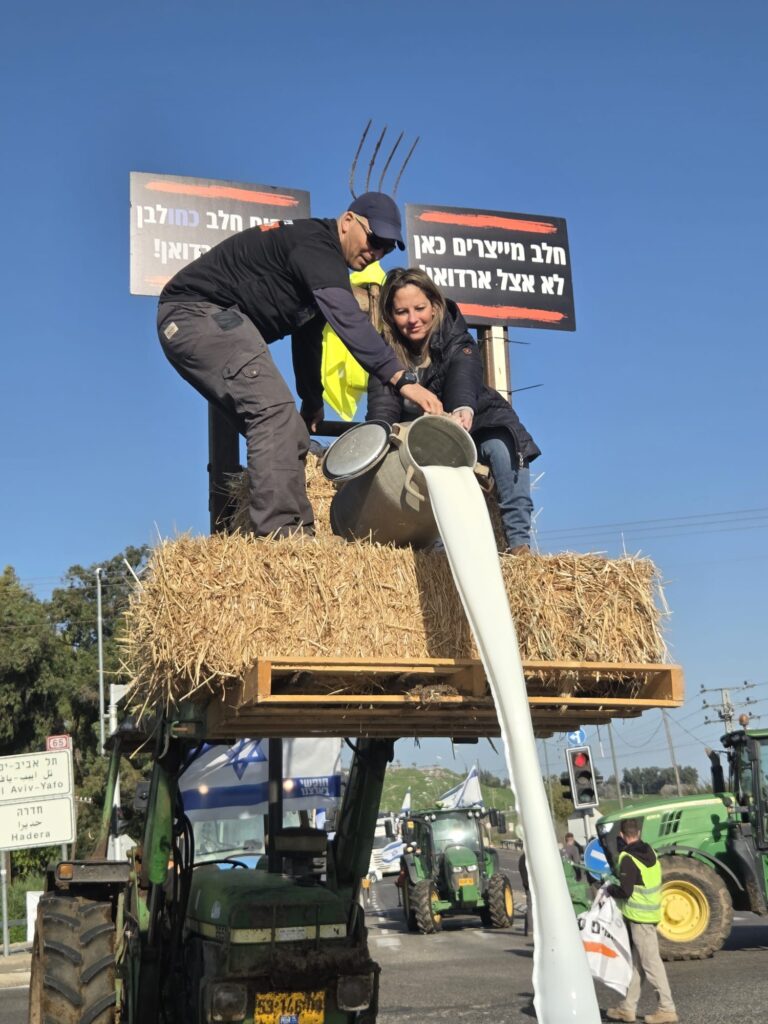
Also joining the protests were the chair of the Regional Council Center and head of the Merhavim Regional Council from Likud, Shay Hajaj, who expressed opposition to the reform. He said he expects the government “to sit with us in order to reach a fair agreement.”
MK Alon Schuster (Blue and White), former Minister of Agriculture, and MK Mati Tzarfati-Harkabi (Yesh Atid) attended the protest at Bilu Junction. Schuster said: “Without a strong local agriculture sector, we will be dependent on importers and foreign countries. Smotrich’s reform will not lower prices.”
Amit Yifrah, chair of the Israel Farmers’ Association and secretary-general of the Moshavim Movement, said: “We will not allow the Finance Minister to destroy a century-old blue-and-white production, nor trample the livelihoods of dairy farmers and agricultural workers living on the country’s borders. We will not let the Finance Minister crush and eliminate some 400 moshav dairies for a reform that will not lower consumer prices but will create dangerous dependence on imports.”