
Results, Truth: In the “Election Night” sketch from the American sketch comedy show SNL, a group of young liberals are shown on the night of the 2016 US presidential election. Polls, newspapers and predictions had prepared them for a sweeping victory by Hillary Clinton, which they were planning to celebrate. But over the course of the evening, they gradually discover that Trump is on the verge of winning.
The sketch succeeds in capturing their slow and painful adjustment to reality: the gap between the America they had imagined in their minds, and which had been echoed back to them by the media and the circles they moved in, and the America that actually turned out to vote against their views. The only one who is not surprised is their African-American friend (Dave Chappelle). When one of the women excitedly declares at the beginning, “This is going to be a historic night!”, he replies: “Maybe. But let’s wait and see. It’s a big country.”
Many Israelis discovered last Wednesday that even small Israel is a big country. There are many people in it who support Likud and Prime Minister Benjamin Netanyahu, even after 7 October and the changes to the judicial system. There are also many people who genuinely believe that he should be replaced. There are very few Haredim looking for a modern political alternative. And there are many Arabs.
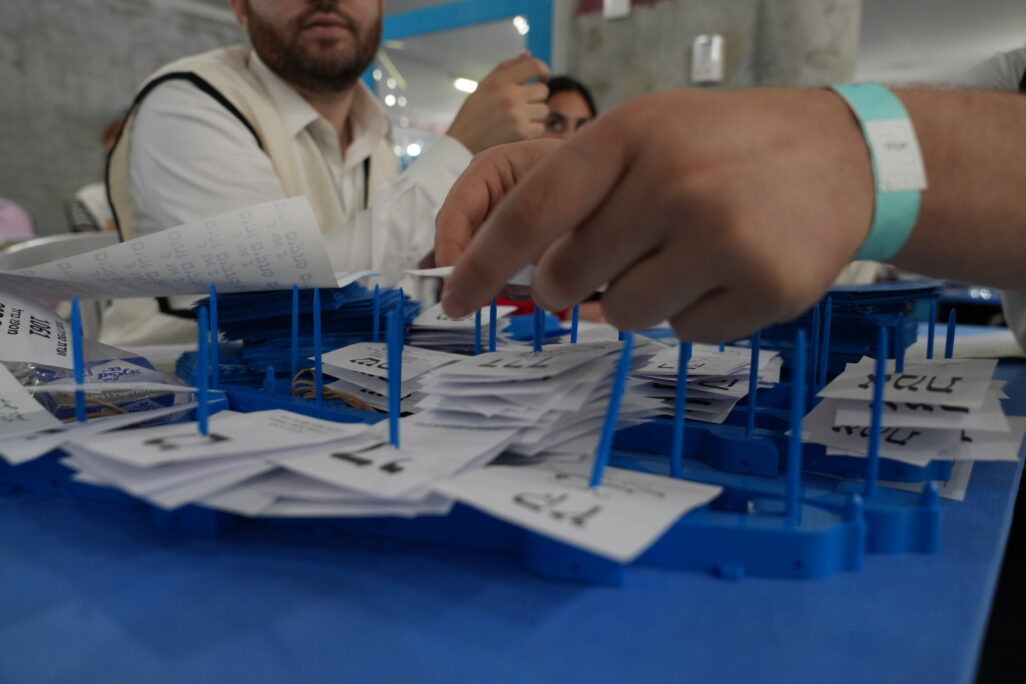
The power of elections to turn your stomach lies in the fact that they produce real results. Not a poll, television studio discussion, commentary or academic research. A physical ballot, placed by a real person into a cardboard box, sent off, sorted and counted. Airy images and dreams collapse in the face of hard reality.
People are more complex than the ballot they cast. The full range of feelings, opinions and thoughts cannot be averaged out into a single decision between alternatives that you did not choose. A walk around the polling stations shows that voters are far less decisive than the ballots they cast. And alongside this, any proposal that seeks to disregard the voter's will is an undemocratic one. The starting assumption must be: this is what people chose, because this is genuinely what they think. These are the results, and there are no others.
Democracy is working: the mass turnout of Arab voters is an important and justified democratic moment. Netanyahu’s last government was unlike the right-wing governments that preceded it. Minister Itamar Ben-Gvir and Minister May Golan pursued an explicit policy of mistreating the Arab public. This was not just incitement on social media, but also the actual diversion of budgets, abandonment, indifference and disregard for human life. In terms of the results, the lives of Arab citizens of Israel are worse today than they were a few years ago because of this government. An excellent reason to vote against it. This is the truth revealed at the ballot box, and it must be given political expression.
On the face of it, this should pave the way for a change government with Arab support. But even without getting into a discussion of the parties and their positions, there is a problem here. Israel is engaged in a prolonged military confrontation, whose end is still a long way off. One can disagree with the way Netanyahu has managed it, but one cannot escape the fact that it is still ongoing. One can argue that a partnership with the Arab parties should be accompanied by bringing it to an end, but again, without getting into the principled debate, the reality is that there is no such coalition. Most of the parties in the Change Bloc have supported a hardline security approach, even if they differ on certain aspects.
The implication for the Joint List in this regard is straightforward. A party whose members opposed the war, accused Israel of genocide and even joined the lawsuit at The Hague can be expected to use the tools at its disposal to exert pressure against Israeli military operations. In this respect, it makes little difference whether its support takes the form of a confidence-and-supply arrangement or a partnership in the coalition – the government depends on their votes to remain in power.
The question is more complicated when it comes to Ra’am. Abbas himself said after the Change Government that he did not want to be the 61st vote again, but has since changed his position. An inciting campaign is trying to portray Ra’am as a revolutionary Islamist offshoot, but Abbas is required to speak to a different audience, as can be seen in his reluctance to state that Hamas is a terrorist organisation. All in all, he is one of the bravest leaders in Arab society, and in Israel more broadly, but he too operates within the constraints of a particular discourse and public opinion. In any case, in the current situation, he alone is not enough to form a government.
It may be that this is not the case, and that the Arab parties could give the government a complete security exemption. But the truth is that there is no way to know. At this point in time, after 7 October and amid an ongoing struggle, Israeli citizens need to know that no political consideration will enter into decisions concerning their basic security. That the Israeli government will be able to launch a counterattack if necessary without having to take into account whether doing so would jeopardise its stability. Clearly, legitimate concerns will be accompanied by another layer of incitement, but even if we set that aside, this would be a very unstable arrangement, which would constantly be challenged from both within and without. The risk on the other hand is enormous: a Jewish-Arab partnership in government established under such distorted conditions and then collapsing could drive Arabs away from politics for years to come.
In light of the results, a way must be found to include the Arab parties in the political game after the election, at the very least Ra’am, which is prepared to pay a heavy price for partnership. But beyond questions of values, relying on them to form a coalition under the current conditions is not a viable plan.
The Death of the Anti-Netanyahu Movement: Three years after 7 October and four years after Yariv Levin presented his plan, one of the facts to emerge from the latest election is that Netanyahu is still the most popular politician in Israel, with almost a quarter of voters. This can be attributed to manipulation, incitement or simply forgetfulness. At the same time, we also need to consider the possibility that many voters are simply satisfied with the policies the prime minister has pursued since then.
My view is that Netanyahu should have left the political stage long ago. He can also be credited with several correct, decisive decisions, but he is responsible for 7 October and is obstructing an investigation into it. He is the leader of neoliberalism in Israel. He has no restraints, and is willing to incite and undermine institutions in order to remain in power. He legitimised Ben-Gvir, and now Feiglin. He dismantled the rotation government with Gantz, and he could do it again.
The reality remains unchanged: there is no stable government without Netanyahu. The formula of “Likud without Netanyahu” is a fiction for which there is not a shred of evidence of its feasibility. The anti-Netanyahu movement is dead as a political project. Morally, this is still a position one can hold and make decisions on the basis of. In fact, the election results prove that it is a very popular position. But as a movement with a political horizon – the formation of a stable government without Netanyahu – it is over.
A fully right-wing government – that is, the current coalition – also appears to be a difficult project to realise. These elections are being presented as the exhaustion of the Change Bloc’s strength, but the right also made a tremendous effort to win. Another election might shift the balance, but it is very difficult to assume that it would shift it enough. The blocs are fairly stable internally, and in the current reality, even if someone crosses the line by a single vote, neither side can form a government that would enjoy broad public legitimacy.
A Government of Necessity: The only path to political and social stability at the moment is a unity government. Nobody wants it: Netanyahu is more comfortable coasting towards another election. The leaders of the Change Bloc have no motivation whatsoever to be at Netanyahu’s mercy. Even the Israeli public rejected this option – all the parties that proposed it were wiped out.
But the truth is that there is no other choice.
There are moments when a people determined to survive must find an option where none seem to exist. They must look reality in the eye and choose between the options available. There is no need to sell dreams – this is not the birth of a new political movement. It is not the discovery of a values-driven Israeli centre. It will not solve the crisis of polarisation in liberal democracy in the West. It is not even really a unity government. It is a ceasefire.
I do not have answers to the many political questions that such a decision raises: the investigation into 7 October, Netanyahu’s trial, and a thousand other questions. But we need to try to put everything on the table. Simply because there is no other choice.
This will not be the government that reforms the judicial system or passes comprehensive conscription legislation. It will be a limited government, seeking to manage Israel’s political deadlock in less violent ways. It will move slowly and operate incoherently. It will work within a very narrow area of consensus: responsibility for Israel’s security, the proper functioning of state institutions, and making a number of appointments by agreement. It will not try to bridge all the disagreements, but rather to restore some of the rules of the game. Perhaps it will rise to something greater, or perhaps it will fall apart in chaos.
But the truth revealed by the final results is this: there is no other choice.